


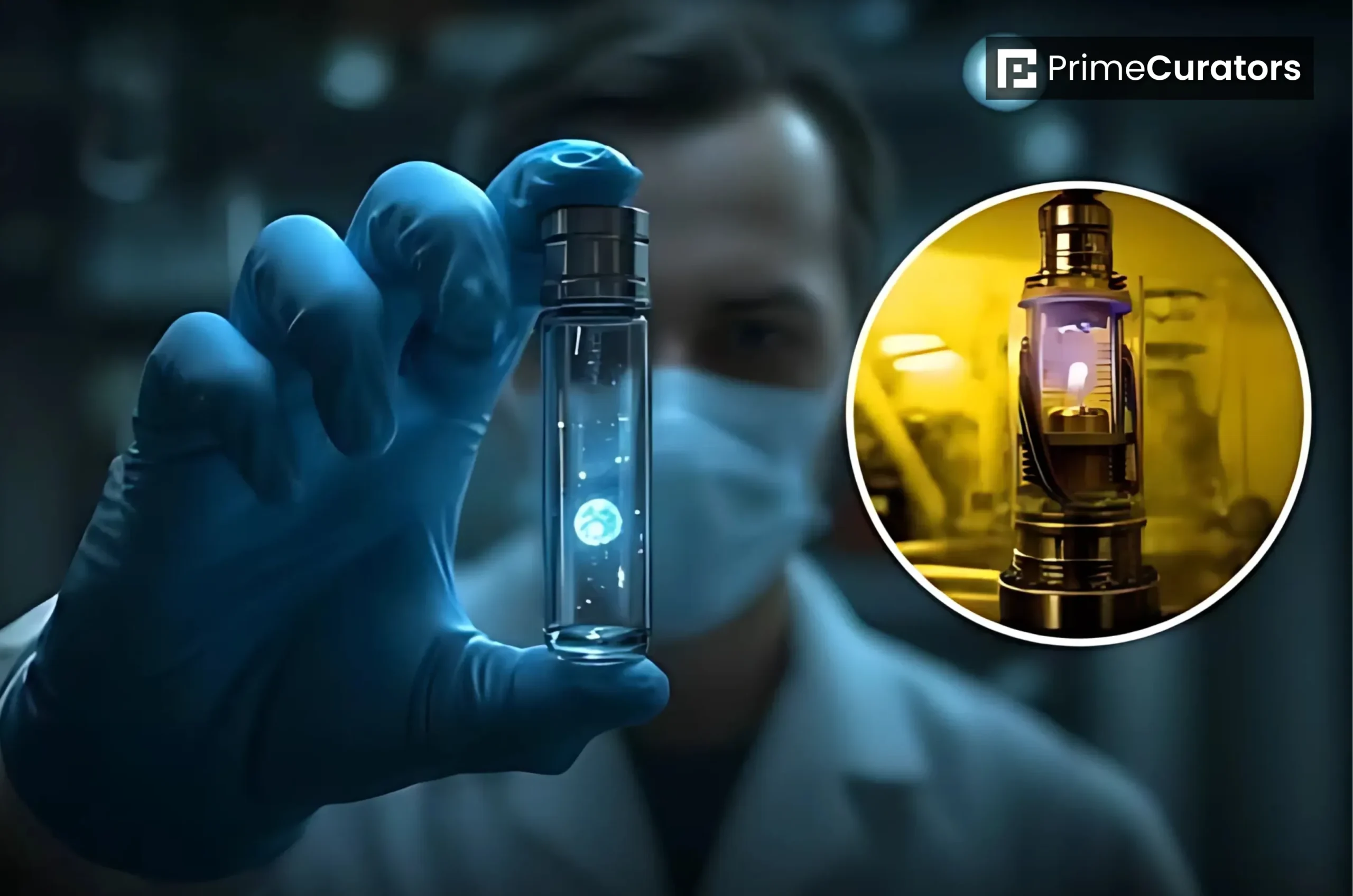
$62.5 Trillion Per Gram: Antimatter, The World’s Most Expensive Material
When we think of the world’s most expensive materials, our minds often go to gold, platinum, or diamonds. But the true champion of value is far more exotic — antimatter. Scientists estimate that producing just one gram of antimatter would cost a staggering $62.5 trillion, making it the priciest substance humankind has ever attempted to create.
What Exactly Is Antimatter?
In simple terms, antimatter is the mirror opposite of ordinary matter. Every particle has a corresponding antiparticle with the same mass but opposite charge. For example, the electron has a counterpart called the positron.
When matter and antimatter meet, they annihilate each other and release 100% pure energy. To put this into perspective, one gram of antimatter reacting with matter could produce energy equivalent to a nuclear explosion — without radioactive fallout.
This unique property is why antimatter has captured the imagination of scientists, futurists, and even science fiction creators for decades.
Why Is Antimatter So Expensive?
Creating antimatter isn’t as simple as mining or refining. It can only be produced in specialized particle accelerators, such as those at CERN ↗ in Switzerland.
Currently, global facilities can produce only a few nanograms of antimatter per year. Even then, capturing and storing it is nearly impossible, since antimatter vanishes instantly upon contact with matter unless kept in magnetic or vacuum traps.
The extraordinary infrastructure, energy requirements, and containment challenges explain the mind-boggling cost of antimatter production.
The Future of Antimatter: Sci-Fi or Reality?
Though antimatter sounds like something out of Star Trek, its potential real-world applications are being seriously studied. Scientists at NASA have suggested that antimatter could one day be used as fuel for interstellar spacecraft, offering speeds far beyond traditional rockets.
There’s also hope for breakthroughs in medical science. Positron emission tomography (PET scans) already use positrons — a type of antimatter particle — to create detailed images of the human body. If production becomes more efficient, antimatter could revolutionize cancer treatment by targeting and destroying tumors with unmatched precision.
Still, we’re decades away from large-scale use. At its current cost and difficulty of production, antimatter remains a scientific curiosity rather than a practical tool.
Why Antimatter Matters
Despite its challenges, antimatter research highlights humanity’s relentless curiosity and drive to push the boundaries of physics. It reminds us that the future of energy, space exploration, and medicine may come from the strangest and rarest corners of science.
What was once the stuff of imagination is slowly inching toward reality, one nanogram at a time.
For more fascinating discoveries in science and space, check out Prime Curators’ Science & Space ↗ section.