


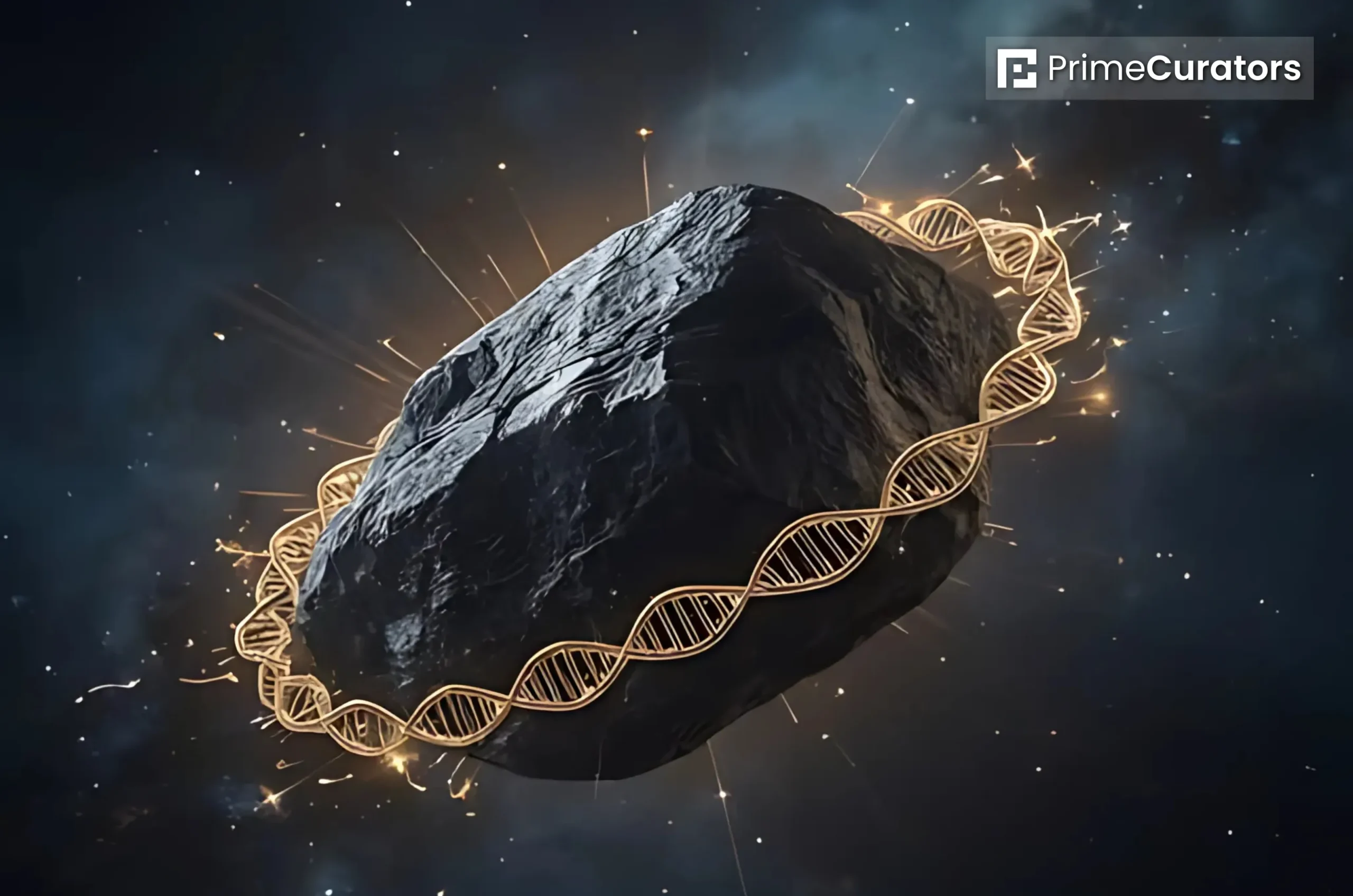
All DNA and RNA Bases Found in Meteorites: Clues About Life’s Cosmic Origins
For decades, scientists have wondered whether the building blocks of life came from Earth or if they were delivered from space. Now, new research provides an extraordinary clue: all five nucleobases essential for DNA and RNA—adenine, guanine, cytosine, thymine, and uracil—have been detected in meteorites.
This discovery, published in Nature Communications (2022), strengthens the theory that life’s essential ingredients may have cosmic origins, arriving on Earth through meteorite impacts during its earliest days.
How Scientists Made the Discovery
The nucleobases were found in carbon-rich meteorites such as Murchison, Murray, and Tagish Lake, which have long been studied for their organic compounds. Using advanced water-based extraction methods and ultra-sensitive mass spectrometry, researchers were able to detect these bases at concentrations as low as parts per trillion.
While adenine, guanine, and uracil had been identified in space rocks before, cytosine and thymine remained elusive because of their fragile chemical structures. With this breakthrough, all five nucleobases that form the blueprint of life have now been confirmed beyond Earth.
For readers curious about how DNA and RNA function as life’s information carriers, resources like the National Human Genome Research Institute ↗ offer accessible insights into genetics.
Why It Matters: Life Beyond Earth
This discovery supports the idea of panspermia, a scientific theory suggesting that life’s building blocks—or even life itself—could be distributed across the universe via comets, asteroids, and meteorites.
If the essential ingredients for DNA and RNA exist in space, it raises a fascinating possibility: life could emerge anywhere in the cosmos where conditions are right. Earth may not be unique—it might simply be one of many places where cosmic chemistry found fertile ground.
Linking Space Science to Earth’s Story
Understanding the origins of life is not just about looking up to the stars—it’s also about tracing Earth’s earliest history. The fact that meteorites delivered these nucleobases suggests that the early Earth environment was seeded with organic compounds, providing a “starter kit” for the chemistry that eventually led to biology.
This research also ties into other milestones in astronomy and biology. For instance:
- NASA’s Perseverance rover is currently exploring Mars, searching for evidence of past microbial life.
- The James Webb Space Telescope is peering into distant exoplanet atmospheres, checking for chemical fingerprints of life.
Together, these efforts paint a picture of science inching closer to answering one of humanity’s oldest questions: Are we alone in the universe?
A Cosmic Connection to Humanity
It’s poetic to think that the same molecules found in our DNA may have originated from stardust and space rocks. This discovery reminds us that life on Earth is deeply connected to the universe—from the stars that forged our atoms to the meteorites that may have sparked our biology.
As researchers continue to analyze space rocks and simulate early-Earth chemistry, the mystery of life’s origins grows both more complex and more inspiring. What’s clear is that science is bringing us closer than ever to understanding our place in the cosmos.
For more fascinating updates on space, science, and discovery, explore the Science & Space section of Prime Curators ↗.