


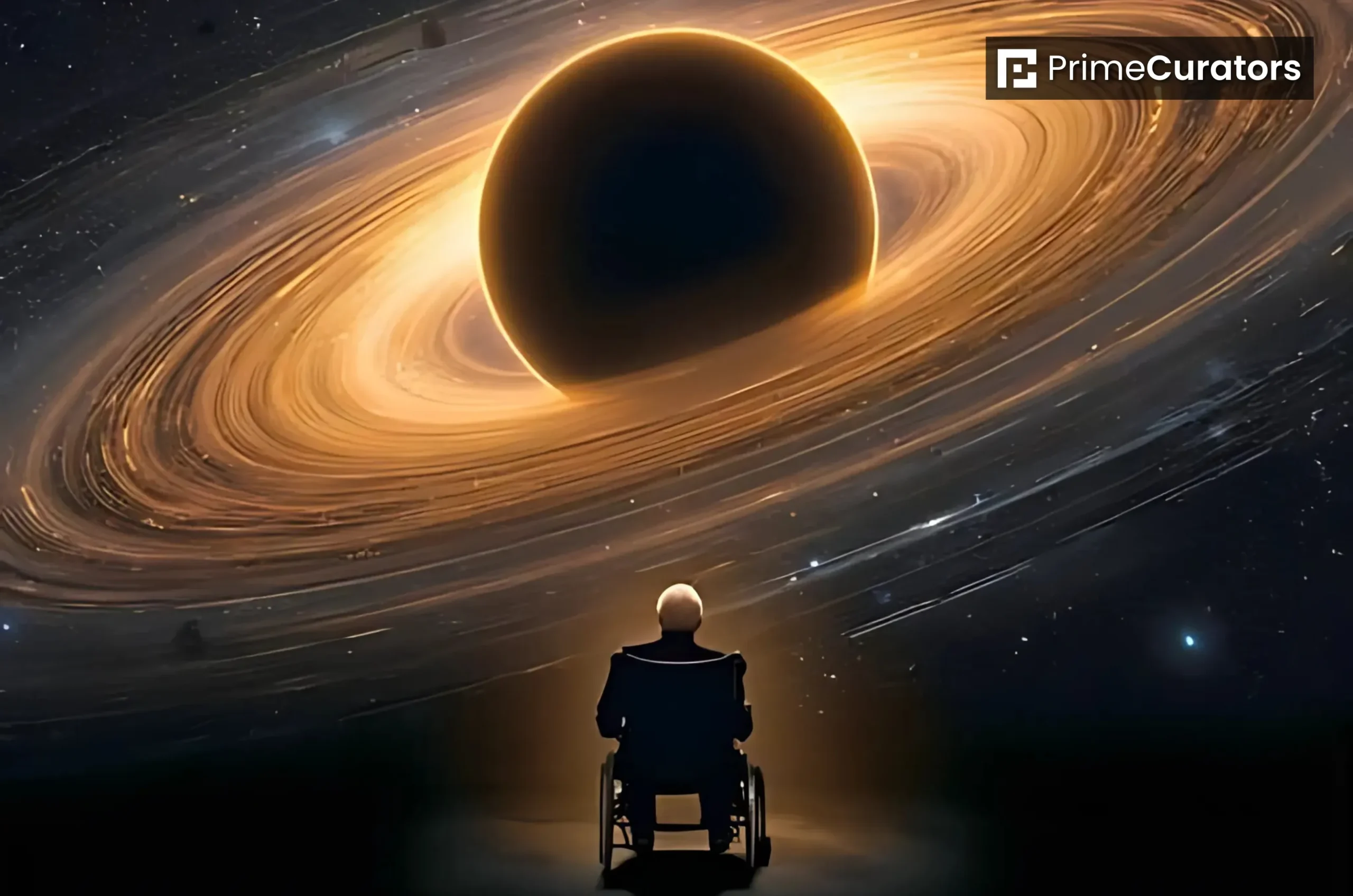
Gravitational Waves Finally Confirm Stephen Hawking’s Black Hole Theorem
For decades, Stephen Hawking’s black hole area theorem stood as one of the most profound ideas in physics. Proposed in 1971, the theorem suggested that the surface area of a black hole’s event horizon—the invisible boundary beyond which nothing can escape—should never shrink after a merger. Now, more than 50 years later, scientists have confirmed this theory with record-breaking precision, thanks to the loudest gravitational wave signal ever detected.
The Signal That Shook the Universe
In 2025, researchers working with the upgraded LIGO observatory picked up a groundbreaking signal, named GW250114. This wasn’t just any detection—it was nearly twice as strong as previous gravitational wave signals, allowing scientists to peer into the cosmic collision of two massive black holes in unprecedented detail.
- Origin of the signal: 1.3 billion light-years away
- The event: Two black holes, each about 30–40 times the mass of our Sun, collided and merged into one larger black hole
- LIGO’s role: Newly enhanced sensitivity—three times stronger than before—enabled researchers to measure the waves and confirm long-debated theories
This monumental discovery wasn’t just about spotting waves in spacetime; it was about validating Hawking’s vision of the cosmos.
What Hawking Got Right
Hawking’s black hole area theorem is often compared to the second law of thermodynamics, which states that entropy (or disorder) in a closed system cannot decrease. Similarly, Hawking proposed that the total surface area of black holes can never shrink when they merge.
By analyzing gravitational wave overtones from GW250114, physicists were able to confirm this prediction with 99.999% confidence. That’s a leap from previous confirmations, which hovered at much lower levels of certainty.
In essence, Hawking’s work continues to hold strong against the most advanced observational tools we have today, reaffirming his place as one of the greatest minds in modern science.
🧠 Related Read:
- How Earth Set to Experience the Longest Solar Eclipse in 100 Years ↗
- How Scientists In Switzerland Created Edible Water Bubbles Made From Seaweed ↗
Why This Matters for Science and the Future
The confirmation of Hawking’s theorem is more than just a tribute to his genius—it’s a step toward solving some of the universe’s biggest puzzles.
- Supports Kerr’s Theory: The findings also back up Roy Kerr’s prediction that black holes are defined solely by mass and spin, with no other distinguishing features.
- Bridging Physics Gaps: With every new gravitational wave detection, scientists are closing the gap between Einstein’s theory of relativity and the still-mysterious world of quantum mechanics.
- Unlocking the Universe: As LIGO and other observatories continue to improve, we’re not just studying black holes—we’re edging closer to understanding how the entire universe works.
For readers who want to dive deeper into astrophysics, Prime Curators also covers breakthroughs in Space and Science ↗, from cosmic mysteries to cutting-edge space exploration.
A Legacy Written in the Stars
This achievement underscores how Hawking’s ideas continue to inspire and shape modern science. What was once a bold theoretical prediction is now a proven fact, written into the very ripples of spacetime.
As detectors grow more powerful, humanity moves ever closer to unraveling the secrets of black holes—and perhaps, the fundamental structure of reality itself.
Stephen Hawking’s voice may no longer be with us, but through discoveries like this, his vision of the universe continues to echo across time.




[…] Gravitational Waves Finally Prove Stephen Hawking’s Black Hole Theorem […]