


Massive Magnetic Forces of Jupiter are Larger Than the Moon and Capable of Enclosing the Sun
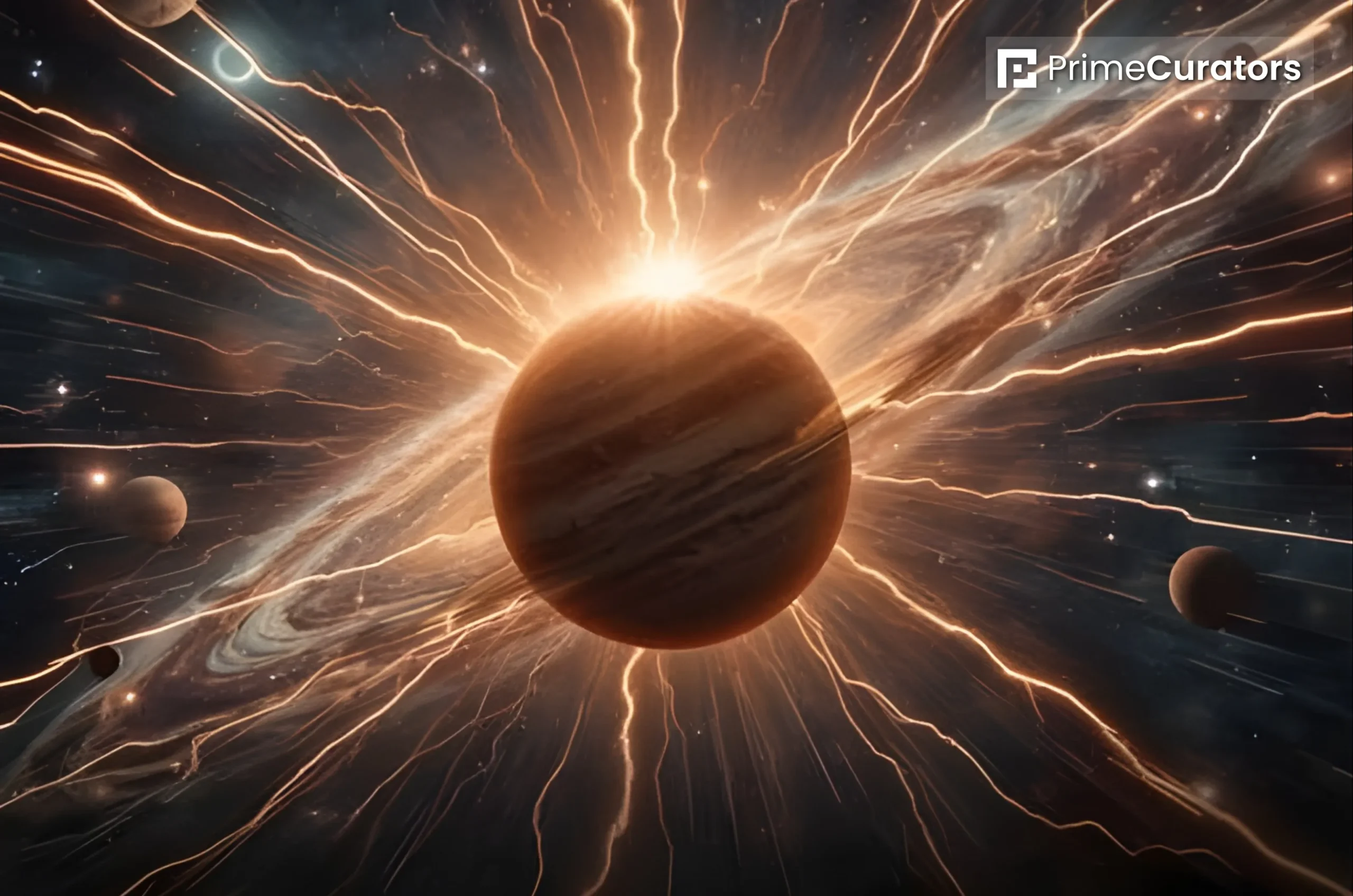
When we think of Jupiter, we imagine the colossal gas giant with swirling storms and its famous Great Red Spot. But beyond its visible beauty lies something even more staggering—Jupiter’s magnetic field, the largest and most powerful magnetic structure in the entire Solar System. Scientists say it’s so immense that, if visible, it would appear larger than the full Moon in our sky.
The Immense Power of Jupiter’s Magnetic Field
Jupiter’s magnetic bubble, also called the magnetosphere, is created by the planet’s internal electric currents deep within its metallic hydrogen core. These currents generate a magnetic force roughly 20,000 times stronger than Earth’s. The result? A magnetosphere that stretches millions of kilometers into space, forming an invisible shield around the planet.
According to NASA’s Juno mission, which has been studying Jupiter since 2016, this vast magnetic region captures charged particles and radiation from both the Sun and Jupiter’s volcanic moon, Io. These trapped particles swirl around Jupiter at high speeds, creating intense radiation belts that are hundreds of times more powerful than those surrounding Earth.
You can learn more about NASA’s Juno mission on NASA’s official website ↗.
Some recent online reports have claimed Jupiter’s magnetosphere is “large enough to enclose the Sun.” While that’s a bit of an exaggeration, it’s not entirely off-base. In sheer volume, Jupiter’s magnetic field could indeed fit the Sun inside it—with room to spare. Imagine an invisible magnetic bubble that could wrap around our star—that’s how vast Jupiter’s magnetic domain truly is.
The Role of Io – Jupiter’s Volcanic Powerhouse
One of the most fascinating contributors to this cosmic phenomenon is Io, Jupiter’s highly active moon. Constant volcanic eruptions on Io release massive amounts of sulfur dioxide gas into space. These gases become ionized and are pulled into Jupiter’s magnetosphere, forming what scientists call the Io plasma torus—a glowing ring of charged particles circling the planet.
This interaction between Jupiter and Io creates dazzling auroras near Jupiter’s poles, far more powerful than those seen on Earth. These auroras have been captured by the Hubble Space Telescope, showing radiant ultraviolet light bursts that pulse in rhythm with Jupiter’s rotation.
For more science and space updates, check out Prime Curators’ Science & Space category ↗.
Solar Winds and Jupiter’s Fiery Response
Even at its enormous scale, Jupiter’s magnetosphere isn’t isolated. It frequently interacts with solar winds—streams of charged particles blowing from the Sun. When a powerful solar storm hits Jupiter, it can compress the magnetosphere dramatically, sometimes shrinking it to half its normal size.
During one such event, scientists observed that the impact heated Jupiter’s upper atmosphere to record levels. The planet’s magnetic field responded like a cosmic drum, vibrating and sending waves of energy through space. These interactions help researchers better understand how space weather affects not only Jupiter but also Earth’s own magnetic environment.
Why It Matters
Jupiter’s magnetosphere plays a crucial role in shielding the planet’s atmosphere from being stripped away by solar radiation—a process that may have doomed Mars long ago. Studying it offers clues about how magnetic fields protect planets and sustain habitability.
Moreover, missions like Juno and the upcoming JUICE (Jupiter Icy Moons Explorer) by the European Space Agency (ESA) will continue to unravel how such massive forces shape the evolution of giant planets and their moons.
Learn more about ESA’s JUICE mission here ↗.
A Cosmic Wonder Beyond Imagination
While Jupiter itself is already a marvel of our Solar System, its magnetic field takes that wonder to a new level. It’s an invisible giant—a dynamic, ever-changing force field that showcases the true power of nature on a planetary scale.
From its volcanic moons to its dance with the solar wind, Jupiter continues to remind us that even in the vastness of space, invisible forces hold the universe together in ways we are only beginning to understand.
Read more fascinating space stories on Prime Curators ↗ and explore how science shapes our understanding of the cosmos.